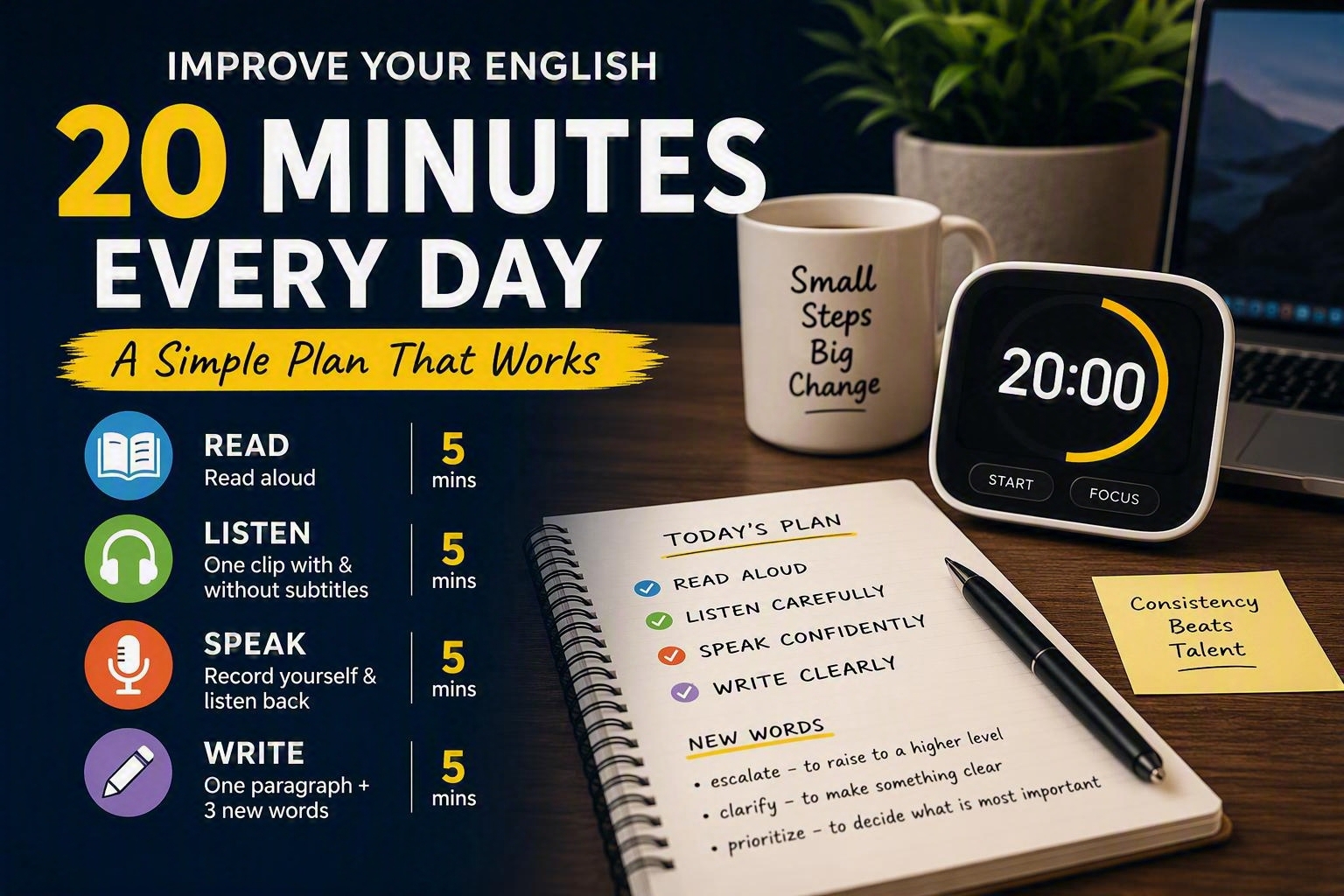
You improve at what you practise, not what you study. Reading grammar rules does very little for your speaking. Watching a video with subtitles does very little for your listening. The plan below forces you to produce English every day, not just consume it.
| Minutes | Activity |
|---|---|
| 5 | Read aloud — one short article or doc section. Out loud, not silently. |
| 5 | Listen — one clip, subtitles on, then the same clip again without them. |
| 5 | Speak — record yourself for 2 minutes about your day, then listen back for 3. |
| 5 | Write — one paragraph, plus 3 new words you met today in your own sentences. |
If even 20 is too much on a bad day: do the speaking block alone. Two minutes recorded, three minutes reviewed. That single habit carries more weight than the other three combined.
Morning - 5 minutes: Read aloud
Pick one article. It can be work-related → documentation, a technical blog, a news piece. Read it out loud, not silently.
Reading aloud does two jobs at once: you absorb sentence structure, and you train your mouth to produce English rhythm. Silent reading skips the second half entirely.
If a sentence feels awkward in your mouth, read it three more times. That awkwardness is exactly the gap you're closing.
5 minutes: Vocabulary that you actually met
Don't download a list of "500 advanced words." Take five words or phrases you genuinely encountered that day — in an email, a meeting, an article — and write one original sentence for each.
Not the dictionary definition. Your own sentence, about your own life.
escalate - "I had to escalate the ticket because the vendor didn't reply in two days."
Words learned in context stay. Words learned from a list disappear in a week.
Commute or lunch - 5 minutes: Listening
One podcast episode or video. First pass with subtitles on. Then replay the same clip without subtitles.
The second pass is where the learning happens. The first pass is just preparation for it. Most people only do the first pass and wonder why their listening never improves.
Evening - 5 minutes: Speak, and record it
Open your phone's voice recorder. Talk for two minutes about your day: what broke, what you fixed, who you argued with, what you're planning tomorrow.
Then → the uncomfortable part → listen back.
You will hear your own filler words, your repeated grammar mistakes, the sentences you abandoned halfway. That discomfort is the most efficient feedback you will ever get, and it costs nothing.
Write something short
One paragraph. A summary of a meeting, a draft email, a few lines about your day. Anything, as long as it's original writing and not copy-paste.